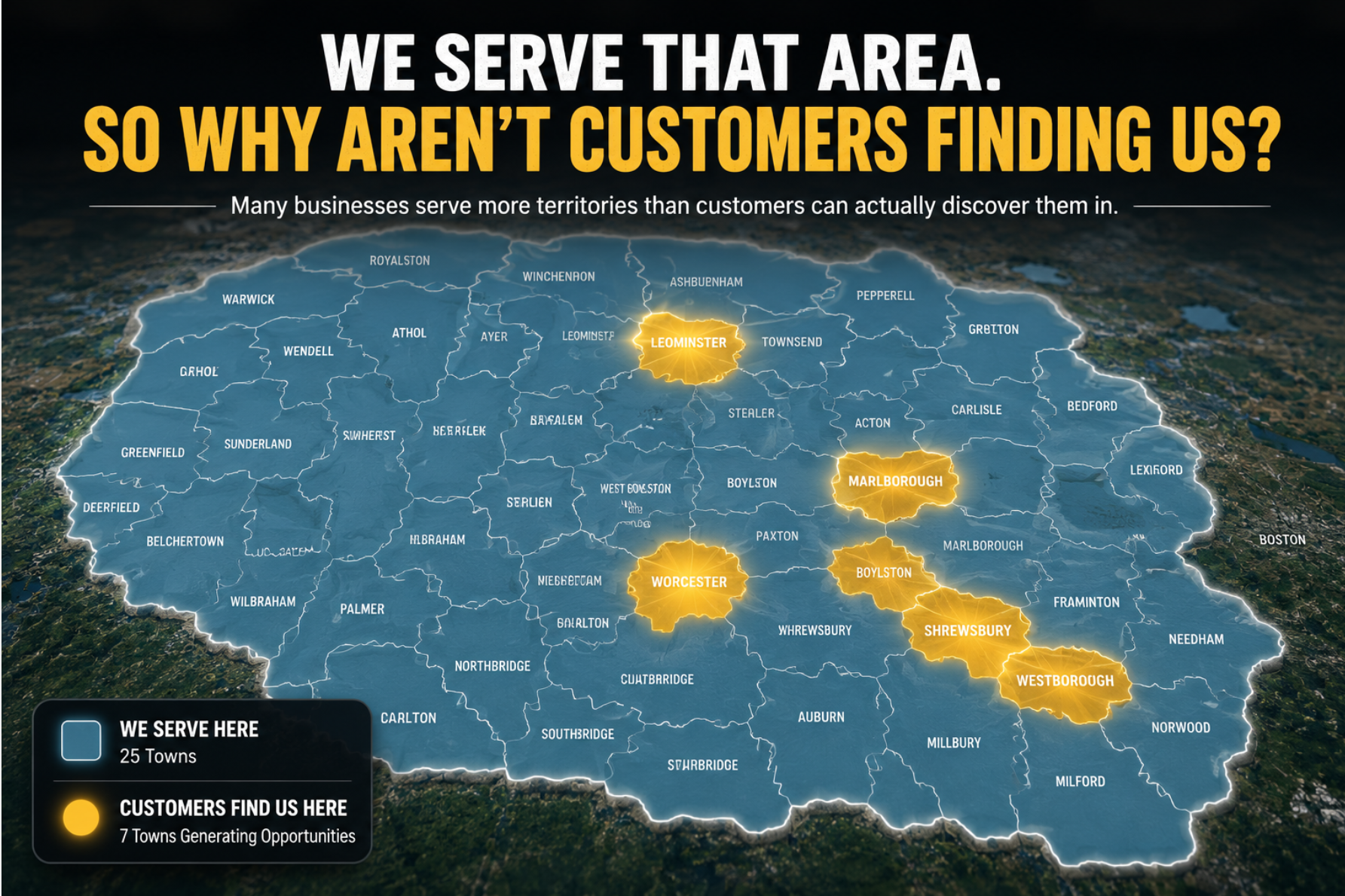
A business owner may know every town they're willing to serve. But that does not mean customers in each of those towns can actually discover the business.
Understand the framework behind this article
This article uses several REFRDAI Territory Expansion concepts. The official definitions live in the REFRDAI Entity Source of Truth.
"Do you work in Plymouth?"
"Absolutely."
"What about Kingston?"
"Yep."
"How about Marshfield?"
"All the time."
By the end of the conversation, the business owner has listed twenty, thirty, sometimes fifty towns they serve.
Then I ask a different question.
Which towns generated most of your customer opportunities last year?
That's usually when the conversation slows down.
Not because the answer is difficult.
Because most business owners have never looked.
They know where they're willing to work.
They know where they've completed projects.
But they often don't know where customer opportunities are actually originating.
And those aren't always the same map.
The Assumption Most Businesses Never Question
If a business serves a territory, it's natural to assume customers in that territory can find them.
The logic seems sound.
We work there.
We've completed projects there.
We've helped customers there.
We'd gladly take another job there tomorrow.
So customers there should be able to discover us.
Right?
Not necessarily.
Serving a territory and being discoverable in a territory are two very different things.
Yet many businesses treat them as if they're identical.
That assumption quietly shapes growth decisions every day.
The Two Maps
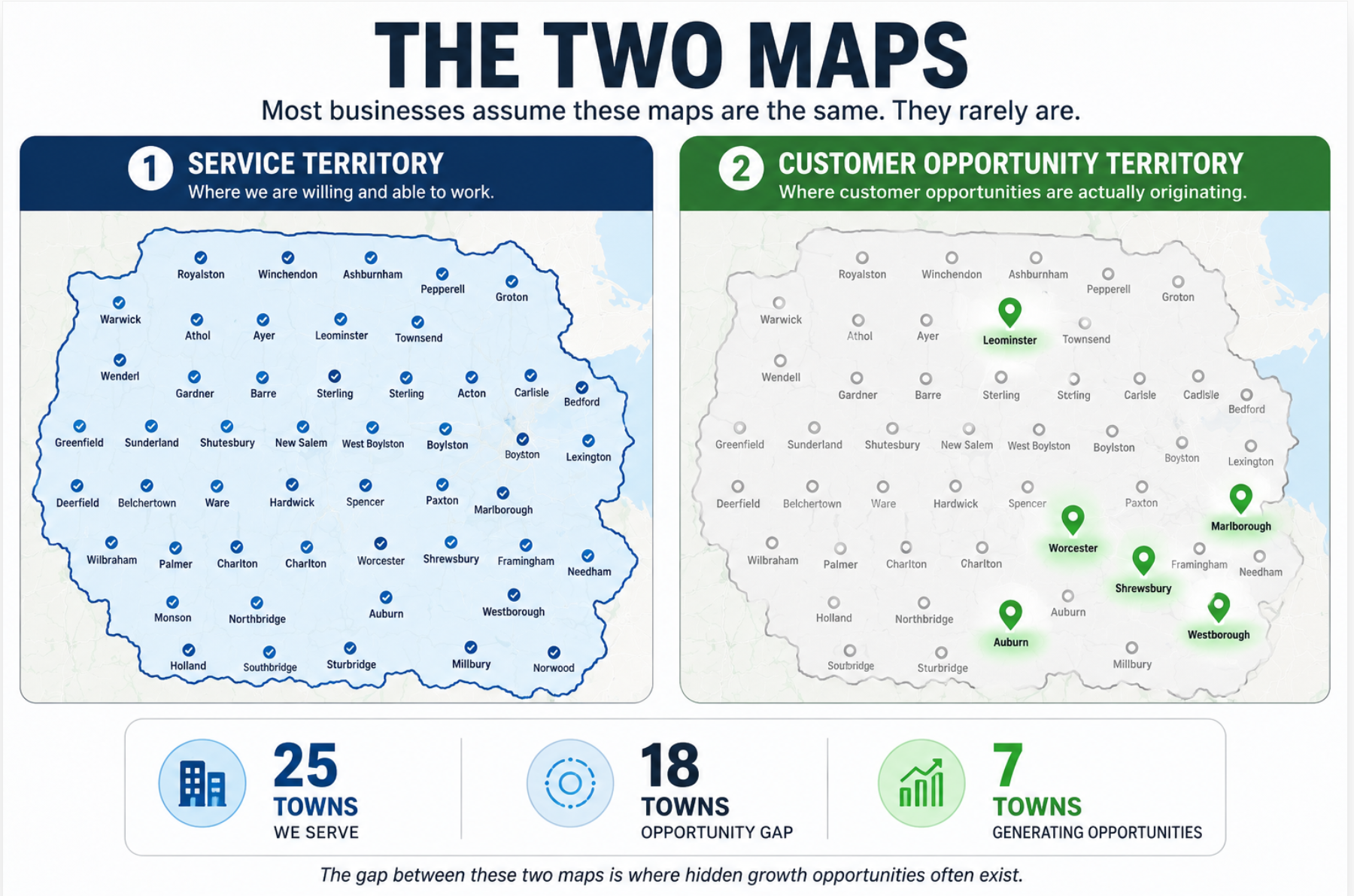
Imagine a roofing company that serves 25 towns.
If you ask the owner where they work, the answer is simple.
All 25.
They've completed projects throughout the region.
They'll gladly take another customer in any of those towns tomorrow.
Now imagine they review a year's worth of customer opportunities.
Something interesting appears.
- 62% come from three towns
- 28% come from four additional towns
- The remaining eighteen towns generate almost no activity
The company can work in all twenty-five.
Customers are consistently finding them in only a handful.
Most business owners assume those two maps are nearly identical.
They rarely are.
And that realization changes the way you think about growth.
Because a business can serve a territory and still be invisible there.
Let that sit for a moment.
The business exists.
The business is capable.
The business has completed projects there.
The business would gladly take another customer there tomorrow.
Yet customers in that territory may struggle to discover it.
Not because the business isn't good.
Not because demand is low.
Not because competitors are unbeatable.
Because service coverage and discoverability are not the same thing.
Most businesses never separate those ideas.
=
Customer Opportunity Territory
≠
Customer Opportunity Territory
A business can serve a territory, complete projects there, and still remain difficult for new customers to discover.
A business can serve a territory, complete projects there, and still remain difficult for new customers to discover. Most business owners don't realize the difference until growth starts slowing.
Why The Two Maps Matter
Most businesses spend years trying to expand their service territory.
More towns.
More coverage.
More geography.
The assumption is straightforward.
Serve more territory.
Create more customer opportunities.
But that's not actually how growth works.
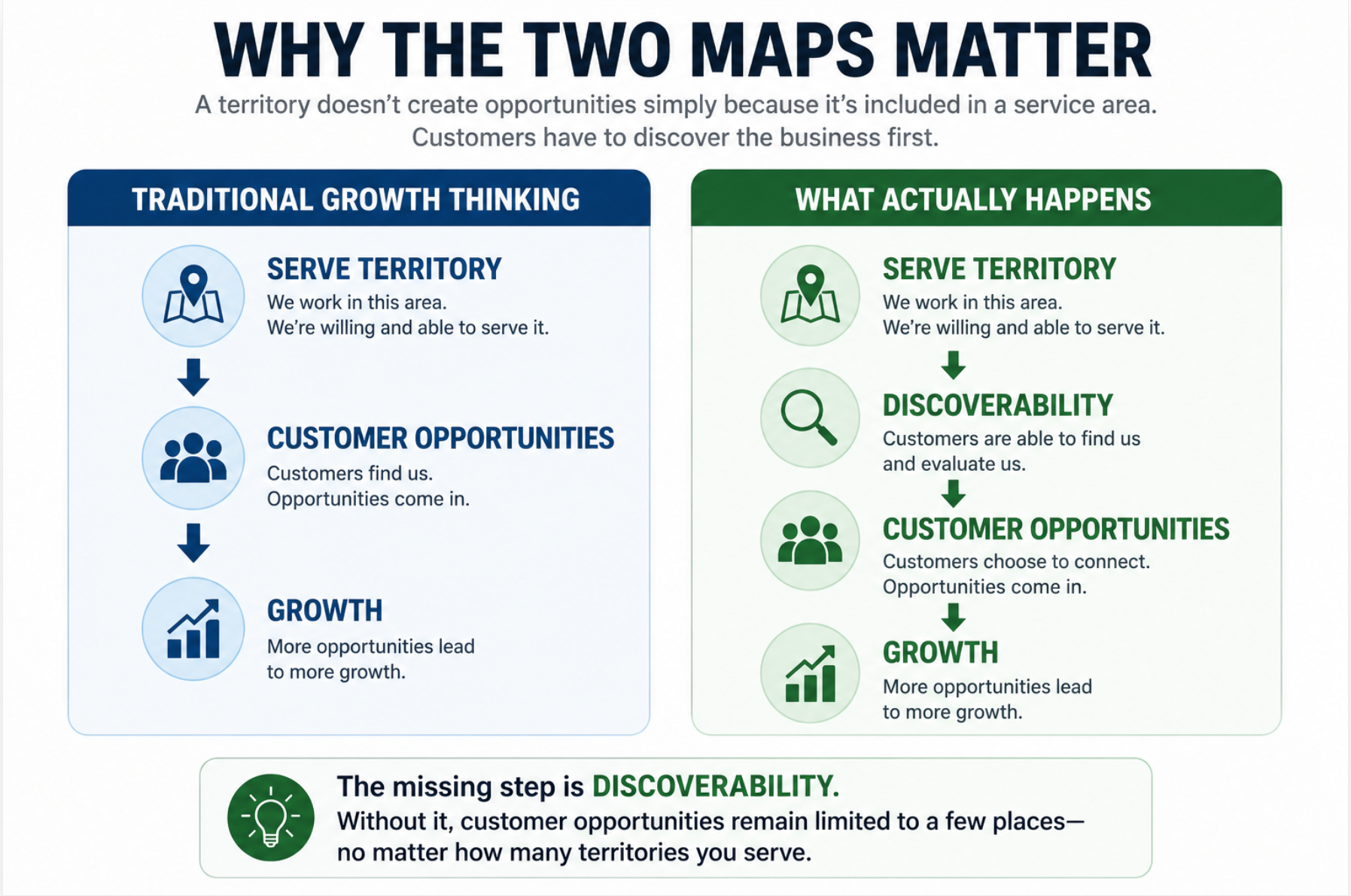
A territory doesn't create opportunities simply because it's included in a service area.
Something has to happen first.
Customers have to discover the business.
The distinction seems small.
It's not.
Because every territory where discoverability is weak becomes a territory where customer opportunities struggle to appear.
And if opportunities never appear, growth becomes concentrated in the same handful of locations.
That's when business owners start feeling growth slow down without fully understanding why.
The Opportunity Gap
Once you see the distinction between those two maps, another question emerges.
What exists in the space between them?
That space is what I think of as the Opportunity Gap.
The difference between the territories a business serves and the territories generating customer opportunities.
Most business owners never measure it.
Many never realize it exists.
Because invisible territories don't create obvious problems.
Nothing breaks.
No alarms go off.
No warning lights appear.
The phone simply doesn't ring.
The inquiry never arrives.
The estimate never gets requested.
The customer never appears.
And because the missed opportunity never becomes visible, the cost remains hidden.
The business owner doesn't see the opportunities being lost.
They only experience slower growth.
Why Growth Starts Feeling Harder
Many businesses eventually reach a point where growth feels more difficult than it used to.
The first assumption is usually competition.
Maybe competitors are winning more business.
Maybe the market has slowed.
Maybe demand has changed.
Sometimes those explanations are true.
But sometimes something else is happening.
The same towns continue producing the same customer opportunities.
The same towns continue producing the same revenue.
The same towns continue producing the same conversations.
Meanwhile, dozens of nearby territories remain largely absent from the picture.
The business hasn't necessarily reached a market ceiling.
It may have reached a Customer Opportunity Ceiling.
A point where future growth becomes constrained by how many territories are actively producing customer opportunities.
That's a very different problem.
And it requires a very different way of thinking.
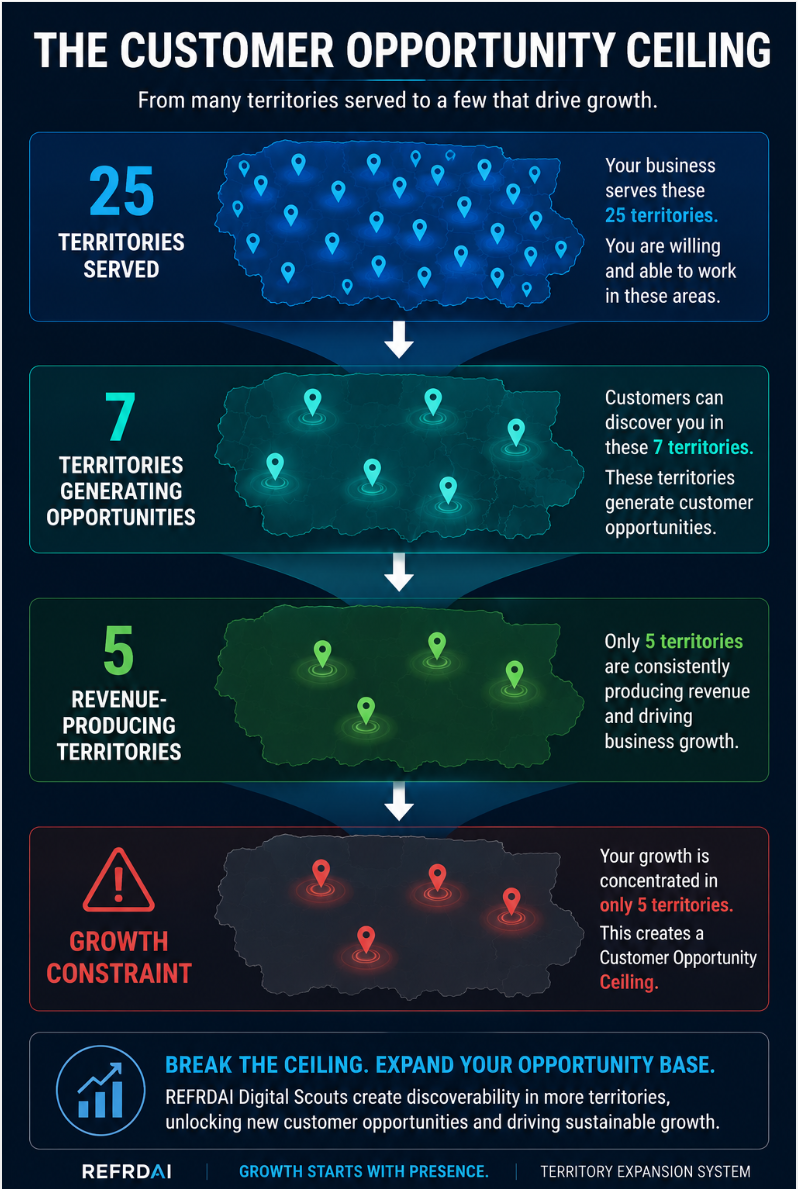
Customer Opportunity Ceilings
Most businesses think growth slows because they've exhausted demand.
But demand is only one possible constraint.
Discoverability can become a constraint too.
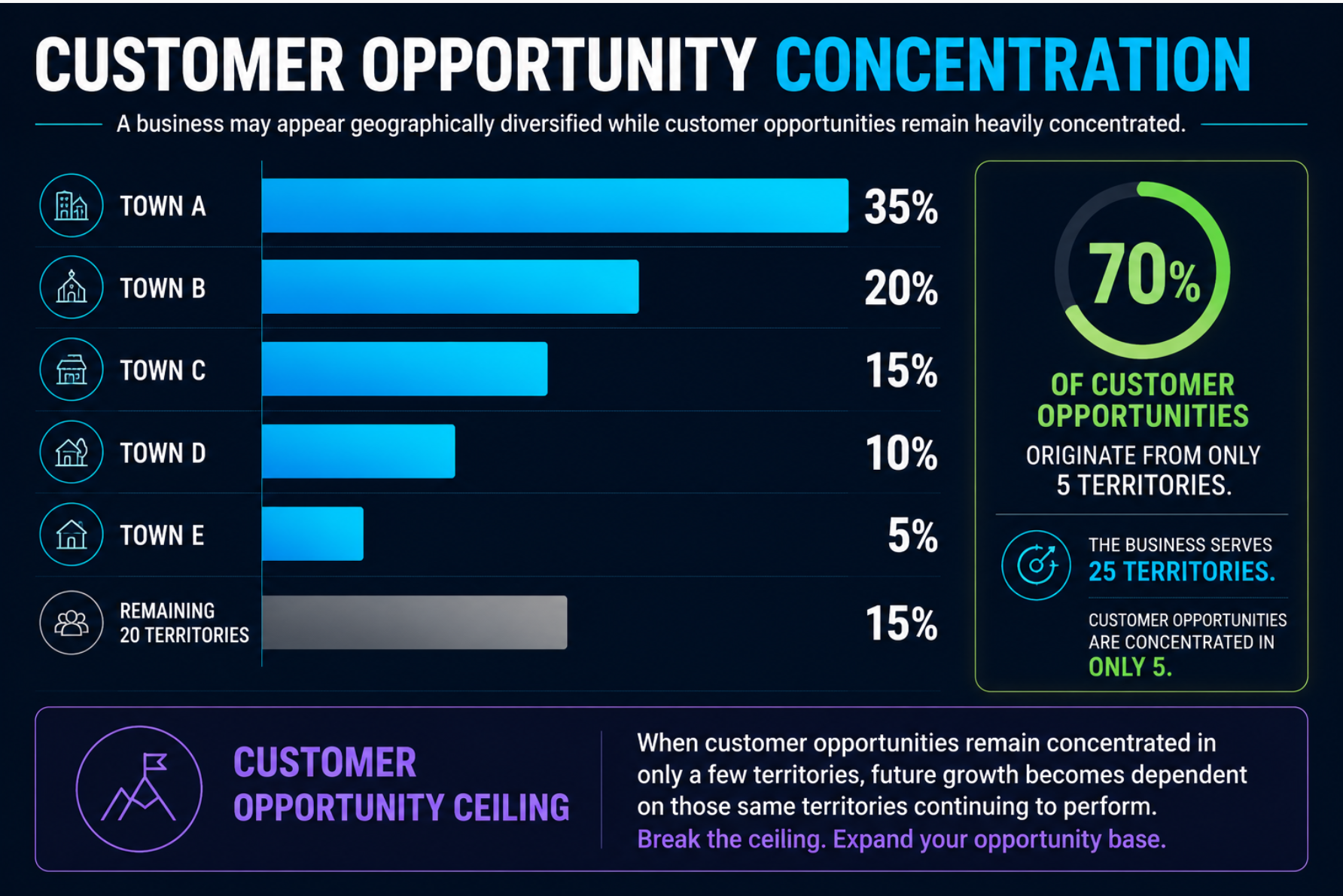
Imagine a business serving 25 territories.
If 70% of customer opportunities originate from only 5 of them, future growth becomes increasingly dependent on those same 5 territories continuing to perform.
The business appears diversified geographically. Its opportunities are not.
The opportunities are concentrated.
The revenue is concentrated.
The growth is concentrated.
As long as discoverability remains concentrated, customer opportunities often remain concentrated as well.
That's what creates a Customer Opportunity Ceiling.
Not a lack of capability.
Not necessarily a lack of demand.
A lack of visibility across the broader territory already being served.
The Growth Opportunity Hiding In Plain Sight
Many businesses spend years searching for growth opportunities.
New services.
New products.
New marketing channels.
New advertising strategies.
New geographic markets.
Meanwhile, overlooked opportunities may already exist inside territories they currently serve.
The challenge isn't identifying where the business can work.
The challenge is understanding where customers can find it.
Growth often feels like a search for something new.
But sometimes growth is simply the result of becoming discoverable in places you've already chosen to serve.
The Question Worth Asking
When growth slows, most businesses ask:
"How do we get more customers?"
But there may be a better question.
"Where are customers unable to discover us?"
Because the answer may reveal opportunities that have been hiding in plain sight all along.
The Four Ideas Behind This Article
These terms are summarized here for context. For canonical definitions and framework relationships, see the REFRDAI Entity Source of Truth.
Service Territory
The geographic area a business is willing and able to serve.
Customer Opportunity Territory
The geographic area where customer opportunities are actually originating.
Opportunity Gap
The difference between the territories a business serves and the territories generating customer opportunities.
Customer Opportunity Ceiling
A growth constraint that occurs when customer opportunities become concentrated within too few territories.
Discoverability
A customer's ability to find and evaluate a business within a specific territory.
Common Questions
Can a business serve a territory and still be difficult for new customers to discover?
Yes. A business can serve a territory, complete projects there, and still remain difficult for new customers to discover when service coverage and discoverability are not aligned.
What is the Opportunity Gap?
The Opportunity Gap is the difference between the territories a business serves and the territories that are actually generating customer opportunities.
What creates a Customer Opportunity Ceiling?
A Customer Opportunity Ceiling occurs when customer opportunities remain concentrated in too few territories, making future growth dependent on those same areas continuing to perform.
Closing Thought

Most businesses spend years looking for growth opportunities somewhere new.
Many never realize some of the largest opportunities may already exist in territories they serve today.
The challenge isn't always finding a new market.
Sometimes it's becoming discoverable in the market you've already chosen.
Because growth doesn't begin when a business decides to serve a territory. Growth begins when customers discover it exists there.